
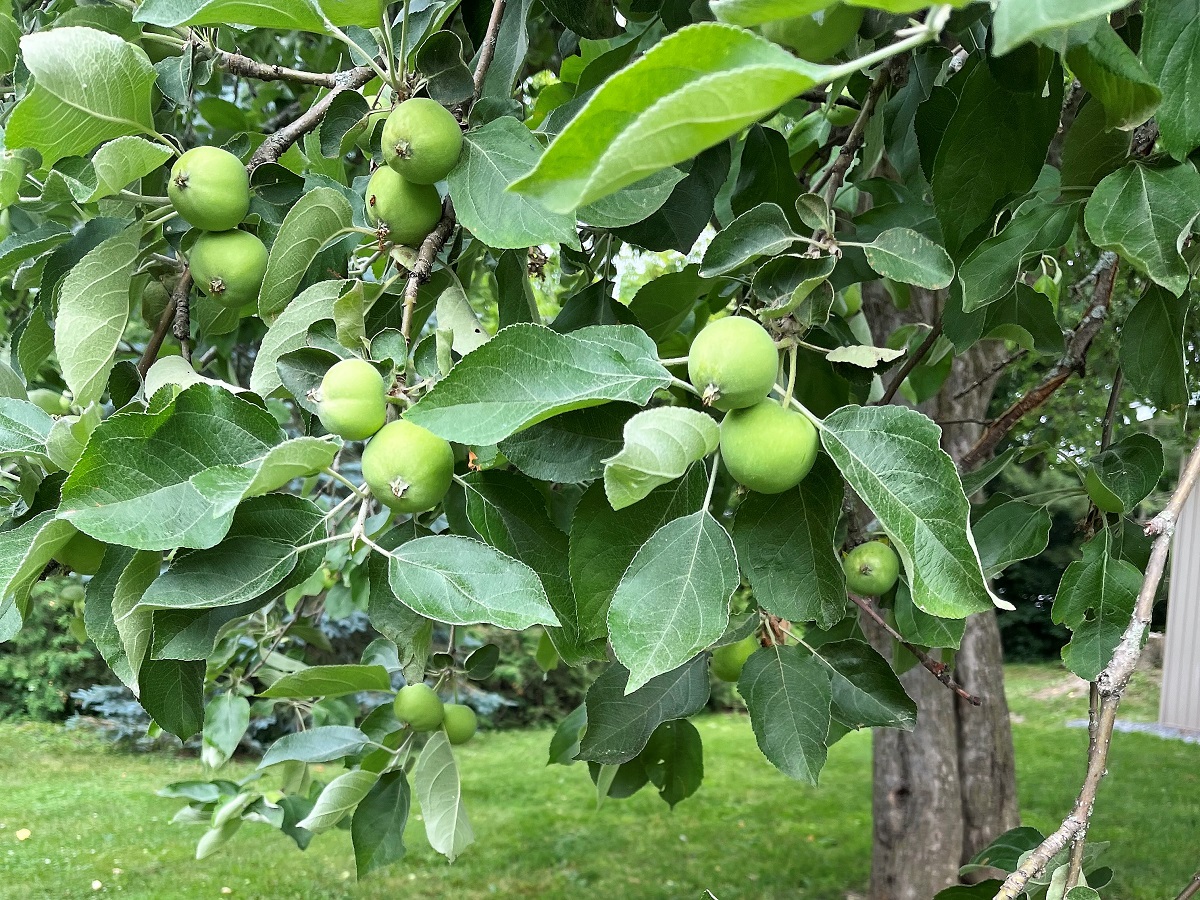
Readers may remember the stories of “My First Apple Tree” from 2021, in which I described how I quickly got overwhelmed in my first experience as an apple tree owner. To say our apple tree was prolific would have been a major understatement.
Along the way, there were many lessons learned that I saved preciously in my back pocket in preparation for future growing seasons.
After the big bounty of 2021, I did some research to see if there was a way to influence the outcome a little… notably, to reduce the number of apples.
I discovered that to improve the size and quality of the yield, it was actually standard practice to prune some of the non-productive branches. Also, experts recommended trimming some of the baby apples (when they grew in a bunch, close together) to enable the remaining ones to have better access to the sun and air flow, otherwise crowded apples can become attractive for bugs.
With trimming and pruning, the tree’s energy can produce a smaller number of larger and healthier fruit.
Bingo! We had our plan!
In a strange twist, 2022 was not a productive year for the tree at all. We have two theories: Either this is a biennual tree, giving us apples every other year, or a weather-related anomaly made it a bad year.
A few days after the apple tree’s blooms were at their peak, we were hit with record high temperatures during which all of the blooms fell, never really allowing enough time for proper pollination. The handful of apples that the tree produced never really matured properly and ended up in our composter.
Either way, it didn’t matter. I did not mind a year off from apple duty.
In spring 2023, with the apple tree in full bloom and the pollinators on active duty, it looked like we were in for a big year.
However, I did not feel the sense of dread that the 2021 season left me with, when we just couldn’t pick or give them away fast enough. This year, we were in a better state of readiness.
In our tool kit we now had:
- A taller ladder to enable us to pick more prime quality apples before they fell;
- Thick grass under the tree to provide a softer landing for falling apples;
- A composter to take care of some of the ones that weren’t fit for consumption (i.e., too green and too small, too many bugs, or landed with a “splat!” resulting in apple sauce on the lawn);
- We now had connections to a nearby petting zoo and a hobby farm to whom we could donate excess and fallen apples to feed their animals;
- For the apples that were of better quality, we had acquired a device to peel, core and slice apples;
- Most importantly, both my partner and I had time, energy and headspace to devote to the tree since we were both retired now.With these tools, we found ourselves better positioned to face the year’s avalanche of apples.
Shortly after the blooms had run their course and the baby apples had formed, it was so easy to pick out the branches that were productive and the ones that were not. I carefully snipped off some of the branches that did not have any leaves or fruit on them, allowing the tree’s energy to focus on the branches where apples were already on their way.
To me, this was actually an enjoyable task. In carefully reviewing each branch, it felt like I was getting to know the tree better than I did in 2021, in letting the old tree tell its story of the good branches versus the ones that had served their purpose.
I read in one source that one should never trim more than 10% of its branches in one iteration or else risk stressing out the tree. Given the size of the tree and the fact that even with our tall ladder, I can’t reach the very top, it was highly unlikely that I’d ever get to the 10% mark.
Over the month of June, you could find me back up in the tree once per week, carefully observing the development of the fruit on each branch. In doing so, I continued to do little trims here and there of dead or dying branches, branches that were blocking the apples’ view of the sun, or trimming a little apple here and there when a cluster was getting crowded.
Shortly thereafter, Mother Nature started dropping some of the baby apples herself. Whether it was because she was choosing the best fruit to carry on or to naturally take care of the crowded cluster situation, I let Mother Nature take the wheel.
At this point, the baby apples were inedible. They were hard, starchy and too tart to try to make anything constructive with them. I even noticed one squirrel pick one up, take a bite, throw it down and carry on with its business. That being the case, to keep the lawn clean, I picked up the apples and tossed them in the composter.
By late July, the baby apples had turned into fully formed and beautiful fruit. A quick tasting told me that it was time to start picking.
Given the tool kit we had assembled and our prep work for this event, apple season was actually a low stress event this year.
Over three sessions, in a three week span, I picked as many almost-ripe apples as I could reach. I would deliver them to my partner who was in the house and ready with the apple peeler-corer-slicer device.
He would get the apples ready for the stock pot to make batches of apple sauce. When the apple picking was over, I would pick up a paring knife and join him in getting the apples ready.
Any apples that didn’t make it into the stock pot, were delivered to the owners of the petting zoo, who were more than happy to take them off our hands to offer a treat to their farm animals.
All in all, the 2023 apple season was a quick one. It was busy but not nearly as intense as the 2021 season was when we were learning everything as we went along.
And now, we have several containers of home-made apple sauce in the freezer, ready to use in our culinary treasures, or just on its own for a refreshing reminder of summer days on a cold wintery night.
Whether our tree decides to offer us more fruit in 2024 remains to be seen.
If it doesn’t because it actually is a biennual tree, then that will offer us some free time to work on something else.
If it does, then we will welcome the season with open arms, knowing that when it comes to the dilemma of a very abundant (almost too abundant) apple tree, we are much better prepared to deal with it.
Did you enjoy this post? If you did, your likes and shares are most appreciated.
If you haven’t already, please check out the rest of my blog at andrebegin.blog. From there, you can click on the “Follow” button to receive future posts directly in your inbox.
Sincere thanks for reading!
Have a great day,
André






 ANDRE BEGIN
Leave a comment